
January 2026 A Life Beneath the City: My 45 Years in Sanitation Work Man Bahadur Pode
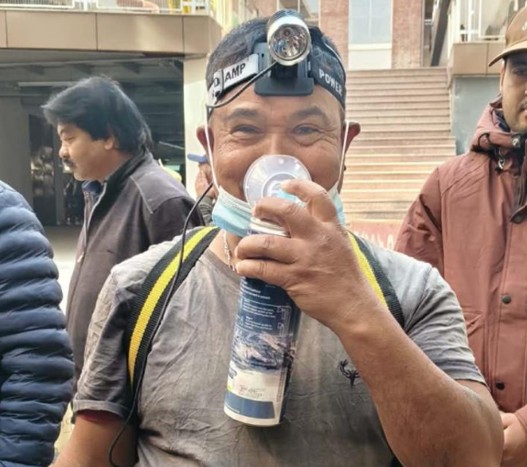
Equipped with a torch and resolve, Man prepares to enter a drainage system built during Nepal’s Rana regime. Phot Credit: Team member from Teamwork Drain Clean Services.
January 2026 A Life Beneath the City: My 45 Years in Sanitation Work Man Bahadur Pode
My name is Man Bahadur Pode. I am 55 years old, and sanitation work has been my life for nearly 45 years. I began this work when I was just 10 years old. Back then, people in Kathmandu believed that small children were best suited for entering septic tanks because we could fit into narrow spaces.
That belief took away my childhood and pushed me into sanitation work long before I understood its risks. At that time, sanitation work in Nepal was mostly informal, deeply stigmatized, unsafe and poorly managed.
I studied until Grade 8. I lost my mother at a very young age and was raised by my grandmother at my maternal uncle’s home. Because of severe financial hardship, continuing my education was impossible. Sanitation work was not a choice, it was survival. “When there is no food at home, you don’t ask what work is safe or respected”
By the age of 15, I was working with a sanitation project supported by German cooperation, which focused on septic tank cleaning in Kathmandu. For the first time, sanitation work was organized. We received training on proper cleaning procedures and the use of equipment. The project helped introduce systems, skills, and some dignity into the work. It also helped me secure a permanent job, in which my main responsibility was manual septic tank entry. The work was physically exhausting and extremely dangerous, but it became my livelihood. I continued this work for decades, until my employer closed and I lost my job. With my savings, I bought an auto-rickshaw, hoping for a safer future. But within a year, the government banned auto services due to pollution. I lost everything and had no option but to return to sanitation work.
Facing Death Inside a Septic Tank
Sanitation work carries different risks for men and women. While women sanitation workers often face wage discrimination and harassment, men are more frequently assigned to sewer and septic tank cleaning, the most dangerous tasks. Deaths from toxic gas exposure and suffocation are not accidents; they are the result of systemic neglect and weak enforcement of safety standards.
One of the most dangerous moments of my life happened while working at a doctor’s house in Teku. As I was opening a septic tank slab, I didn’t realize that toxic gas had accumulated inside. The slab suddenly broke, and I fell into the tank’s second chamber.
Fortunately, my colleague managed to pull me out in time. “if I had fallen into the remaining chamber, I might not be alive today. Despite such incidents, stopping was never an option.”
Essential work in action: manual sewerage cleaning using a pipe rod. Photo Credit: Team member from Teamwork Drain Clean Services.
Living With Discrimination
The physical danger is compounded by the emotional toll. I carry sludge for a living, but the heaviest burden I carry is discrimination. In the past, discrimination was extreme. People avoided us, insulted us and treated us as untouchable because of the smell and the nature of our work. Even today, discrimination remains: some people still refuse to touch us and call our work “dirty”, but they forget that without sanitation workers, cities cannot function.
From Worker to Business Owner
Six years ago, I was finally able to take control of my work and established Teamwork Drain Clean Services. Over the years, I have received multiple professional trainings on safety procedures. However, today, safety practices are often compromised due to intense competition: if we delay work to arrange proper safety equipment, clients immediately call another company. Under this pressure, many sanitation workers take unnecessary risks. “Safety becomes a luxury when competition is high and work is uncertain.”
Working With Gas, Smell, and health risks
With experience, we have learned to sense danger. When we open a septic tank, we can often smell or feel if gas levels are unsafe. In such cases, we open the tank, wait, pour water, and only then begin work. Still, the risk never fully disappears. I never work alone; I always take at least one partner. In older settlements, pipelines have reduced the need for manual cleaning, but in large hotels and modern houses, blocked septic tanks still require manual entry.
Sanitation work causes skin infections, allergies, and long-term health problems. My team and I regularly monitor our health and undergo checkups. I have health insurance, which I use when needed. We wash thoroughly after work and use gloves and masks whenever possible.
Unspoken Realities
There is another reality people rarely discuss. Some workers believe that local alcohol helps them tolerate the strong smell and physical strain. In extreme conditions, some refuse to work without it. “For many sanitation workers, alcohol is not about pleasure, it is a quiet escape from exhaustion, stigma and unspoken pain. It’s not safe or right, but the system gives us no better support.”
Seasonal Work and Uncertain Income
On average, I earn around NPR 60,000 per month, but the work is seasonal. We mainly work for about six months a year, mostly in winter. During the rainy season, drains overflow naturally, and work reduces significantly. My dream is to shift fully to machine-based sanitation work, but a septic cleaning vehicle costs around NPR 25 lakh, far beyond my reach.
A Dream Fulfilled Through My Son
I have two sons and three daughters. At one point, I considered bringing my son into this work, but my supervisor advised me otherwise. He said that since my son is educated, he should choose a different path. I agreed. I do not want my children to face the same risks, discrimination, and hardship that I did. Recently, as I watched him graduate, I felt emotions I had carried quietly for decades. My son has fulfilled the dreams I could never achieve as my childhood was taken away by poverty and sanitation work. When I stood beside him, I felt that every septic tank I entered, every insult I swallowed, and every risk I took had meaning. I did not wear a gown or hold a certificate, but through my son, I felt educated, respected, and proud. “The dreams that ended with me have begun again with him,” because his success is not only his, it is the reward of every sacrifice I made to ensure my children would have a different future.
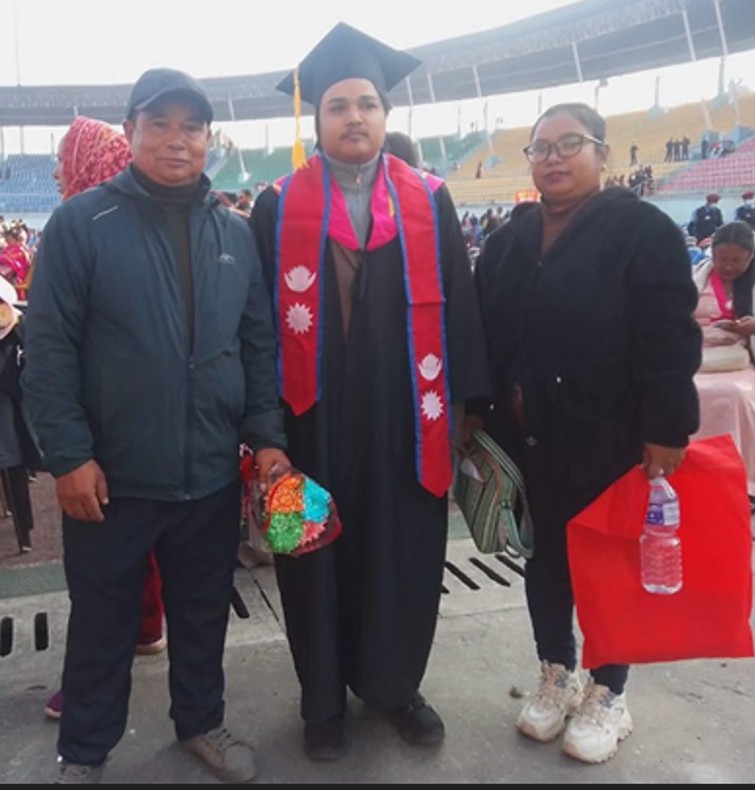
Celebrating a milestone: a proud father at his son’s graduation ceremony, accompanied by his daughter. Moments that truly matter. Photo Credit Wife of Man Bahadur Pode
A Call for Safety, Dignity, and Recognition
Sanitation work was once carried out by a few dedicated individuals. Today, many private companies operate, increasing competition while reducing job security. If the government could better regulate work schedules, allow septic tank cleaning during office hours, ensure proper disposal systems, and recognize sanitation workers as essential public service workers rather than informal labor, our work would become safer and more dignified.
This is my life story. “All I hope for now is a future with more safety, respect, and recognition, for sanitation workers like us.”
Compiled by: Preeti Mittal and Seema Rajouria (WaterAid Nepal) and Srijana Karki (ENPHO)