
November 2026 What George Wears to Work Now: Why PPE programmes for sanitation workers keep failing, and what eight years in Nairobi reveal Elizabeth Mururi, Wali Mwalugongo
A formalised Community Based Organisation in Mukuru, Nairobi, comprising of 26 Manual Pit Emptiers, after going through training, and having received PPEs at a Fresh Life Mtaa Fresh Centre
November 2026 What George Wears to Work Now: Why PPE programmes for sanitation workers keep failing, and what eight years in Nairobi reveal Elizabeth Mururi, Wali Mwalugongo
For years, the sanitation sector has told workers to wear protective equipment, and for years, most haven’t. Protective equipment is distributed, demonstrated and then, mostly, not worn. What do eight years of evidence from a Nairobi programme working with manual pit emptiers suggest?
The last line of defence, treated as the first
In every hazardous industry, occupational safety rests on a principle called the hierarchy of controls - eliminate the hazard if you can, engineer it out where you can’t, and only then (as the final, weakest layer) protect the individual worker with personal protective equipment (PPE). Mining, construction and healthcare all obey this order.
For sanitation workers, and manual pit emptiers especially, the hierarchy is routinely inverted. There is rarely investment in eliminating the hazard of handling raw faecal sludge. Instead, sanitation workers are handed gloves and masks, given instructions, and blamed when the equipment goes unworn. Landmark sector assessments have documented both the severity of the hazards and the thinness of the protections. What has been documented far less is why the equipment goes unworn - from the workers’ own perspective.
Meet George
One longitudinal source of evidence comes from Mukuru, one of Nairobi’s informal settlements, where Fresh Life has worked with the same community of manual pit emptiers since 2017 through its pit waste transfer stations programme. From a health impact assessment of these workers, the programme constructed “George,” a composite of the average emptier. George empties pit latrines manually- by hand with buckets and scoops, and his work exposes him daily to raw sludge.
At baseline, before any intervention, George’s protection was minimal: a mask, never; coveralls, 43% of the time; heavy gloves, a third of the time; only gumboots, at 86%, approached consistency.
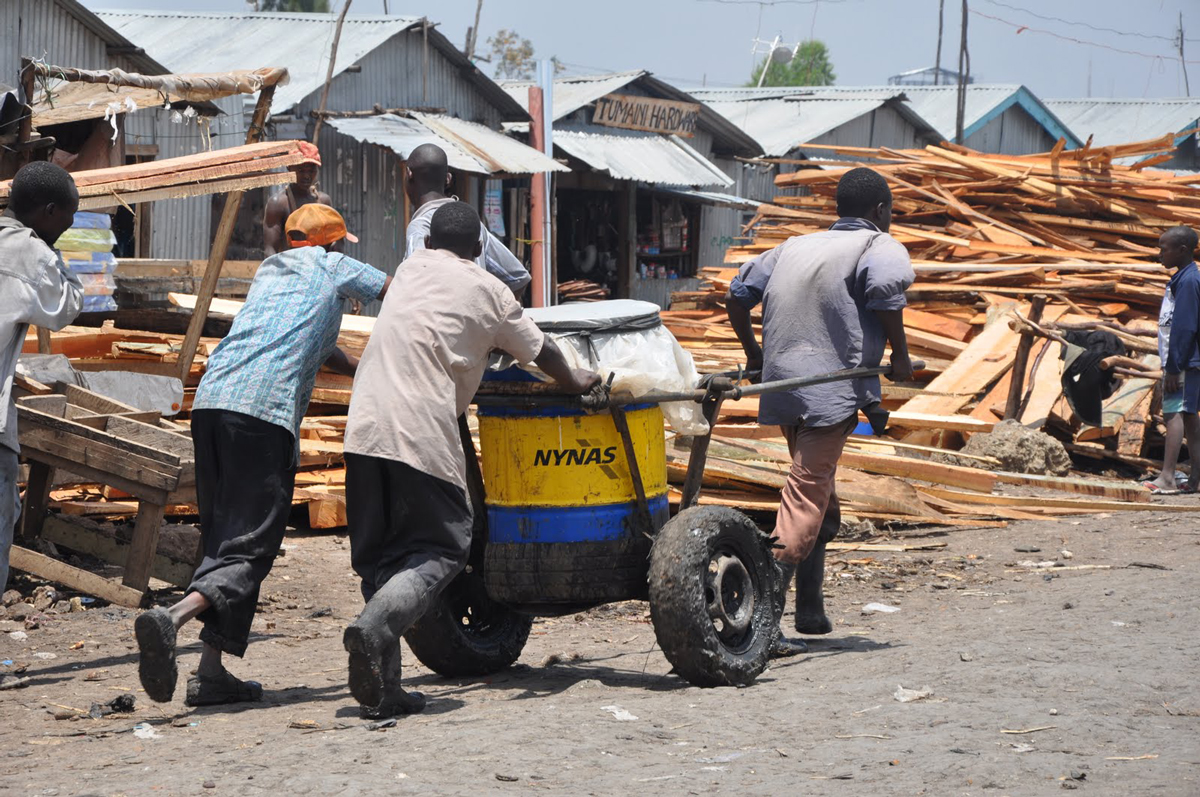
Manual pit emptiers up and about their daily hustle of pit emptying with no PPEs
What the workers said
Focus group discussions with emptiers across two Mukuru settlements, Kwa Njenga and Kwa Reuben, surfaced three explanations. None of them ignorance, and all of them rational.
First, experience. Veteran manual emptiers pointed to decades on the job without visible harm; as one put it, “we have been doing this work for over 20 years without PPEs and nothing has happened to us.” Where risk is invisible and consequences are hard to trace, instruction alone cannot compete with lived experience.
Second, product design. Emptiers described heavy gloves that turn dangerously slippery on the handles of the loaded handcarts they haul; oversized goggles that fog and pool sweat and masks that fight the lungs during the heaviest work of pushing a 200-litre barrel. Different tasks in the emptying process, they explained, need different equipment. A nuance that few standard-issue kits acknowledged.
Third, economics. Some items, once worn out, had to be replaced at the workers’ own expense. A recurring cost for a financially struggling group, for equipment they had not chosen and did not rate.
What moved the numbers
Two interventions shifted George’s wardrobe, and their sequence matters. The first was identity, not instruction: emptiers formalized a community-based organization with its own constitution, and members received branded equipment. Interestingly, workers connected the uniform less to safety and more to legitimacy. Distinguishing a recognized professional group from, in their words, people mistaken for thieves. Belonging preceded behaviour.
The second was co-design. In 2021, Fresh Life partnered with the US Centers for Disease Control and Prevention and Washington State University to develop behavior change and training approaches around the barriers workers had actually named - how to don, doff and maintain equipment under real working conditions - assessed with pre- and post-surveys. This was coupled with enforcement on use of the PPE when visiting the transfer station.
The cumulative result: coveralls worn 90% of the time, heavy gloves 95%, gumboots 100%. As for masks (the item workers’ lungs argue with) a rise from zero to 27.3%! Good progress, albeit the lowest, and evidently more a product-design problem rather than a compliance problem. Meanwhile, every newly joining emptier restarts near the old baseline; one recruit, awaiting his first kit, described working in gumboots, ordinary clothes and a cloth tied around his nose.
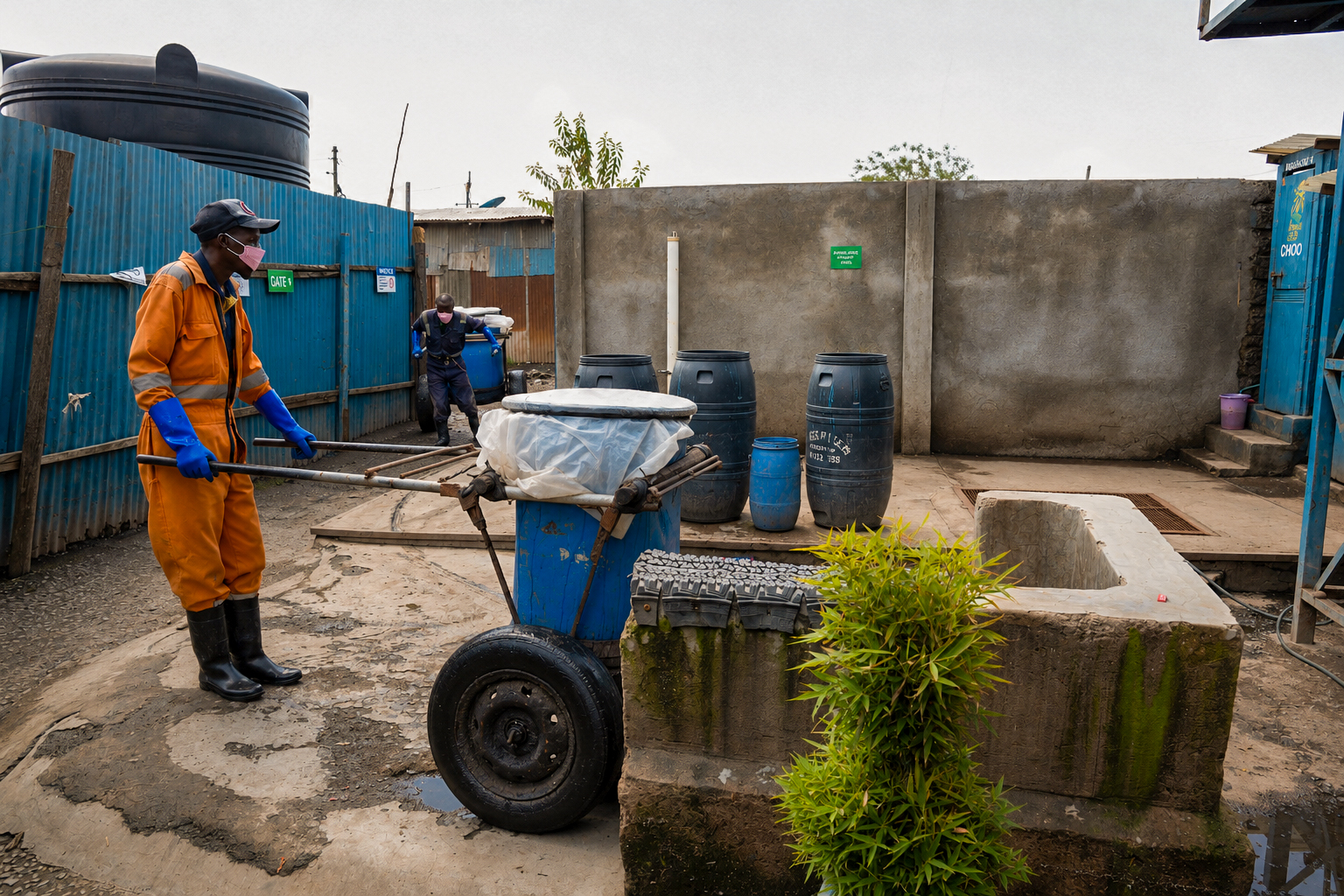
‘George’ fully donned with PPE - part of a CBO now and in partnership with Fresh Life to dispose off pit waste at the Mtaa Fresh Transfer centres
Four implications for the sector
Don’t let the perfect be the enemy of the safer. For utilities, programmes and funders working with sanitation workers anywhere, the Mukuru evidence points to four shifts:.
-
Diagnose barriers that matter before distributing.
-
Build identity before instruction: equipment tied to professional belonging gets worn; equipment tied to a lecture gets shelved.
-
Measure incrementally: a worker in coveralls 90% of the time is a categorically different risk profile from 43%, even with masks unsolved.
-
And restore the hierarchy: PPE should be the floor of worker protection while the sector invests in engineering the hazard itself. Redefine manual pit emptying, create safe discharge points, better tools, professionalized services.
The training materials developed with the workers, CDC and WSU are available for adaptation. George has counterparts in every city with pit latrines. They deserve a sector that stops telling and starts asking.